Key Takeaways
- • Retention journey — Unboxing, onboarding, adherence, loyalty, and order management all matter.
- • LTV — ARPU / churn (simplified); reduce churn and increase ARPU to grow LTV.
- • Cohort analysis — Churn by order number (e.g. 50% by order 3) shows where to focus.
For most established Shopify brands, the biggest opportunity for revenue isn't found in a new acquisition channel—it's hidden within the data of the customers you already have. Customer retention is the key to maximizing lifetime value. For tactics on willful cancellations and payment failures, see active churn and passive churn; for churn math, read churn rate calculation.
The Retention Journey
Effective customer retention requires attention at every stage of the customer lifecycle:
1. Unboxing & First Impression
The unboxing experience sets the tone. Make it memorable, educational, and aligned with your brand promise. Include clear instructions, usage tips, and reasons to believe.
2. Onboarding
Set expectations and teach usage. Upgrade your onboarding with more education and better tools for adherence. Help customers see results quickly.
3. Adherence
Help customers use the product consistently. Send reminders, tips, and encouragement. Make it easy to stay on track.
4. Loyalty
Build emotional connection beyond the transaction. Create moments that matter, recognize loyalty, and make customers feel valued.
5. Order Management
Keep customers informed about upcoming orders. Allow them to skip, delay, or modify orders easily. Transparency builds trust.
Addressing Value Gaps
When customers don't see value, they cancel. Address common value gaps:
- Didn't feel results: Improve onboarding, education, and adherence tools
- Too much product: Add skip order functionality, adjust default intervals
- Too expensive: Offer bulk purchase options or loyalty credits
- Not a fit: Cross-sell complementary products
Customer Lifetime Value Calculation and Optimization
LTV is the total revenue you expect from a customer over their entire relationship with your brand. Understanding and optimizing LTV is the foundation of retention strategy.
Basic LTV Formula
LTV = Average Revenue Per User (ARPU) / Churn Rate
Example: If ARPU is $50/month and monthly churn is 5%, LTV = $50 / 0.05 = $1,000. This is a simplified formula; advanced models also apply a discount rate to future cash flows.
Advanced LTV Calculation (with Gross Margin)
For more accurate LTV, account for gross margin:
LTV = (ARPU × Gross Margin %) / Churn Rate
LTV Improvement Tactics
- Reduce Churn: Even small churn reductions dramatically increase LTV
- Increase ARPU: Upsell, cross-sell, or increase order frequency
- Improve Gross Margin: Optimize product costs and pricing
- Extend Customer Lifespan: Focus on long-term retention, not just short-term revenue
Retention Rate vs Churn Rate
Retention rate and churn rate are inverse metrics that measure the same thing from different angles:
Churn Rate
Percentage of customers lost
Churn = Lost / Total
Retention Rate
Percentage of customers retained
Retention = 1 - Churn
Example: If monthly churn is 5%, retention rate is 95%. Both metrics are useful—churn focuses on the problem, retention focuses on the goal.
Cohort Churn Analysis
Cohort churn analysis tracks groups of customers who joined in the same time period, revealing when and why they churn over time. Understanding these patterns is critical for identifying intervention points and reducing churn.
Understanding Cohort Churn Patterns
Churn analysis reveals critical patterns in when customers leave. However, it's important to distinguish between trial customers and true subscribers: customers who churn before taking a second order should not be counted as subscribers—they're trial customers who never converted.
The reality of subscription churn is stark: By order 3, 50% of customers churn. Most churn happens just before or after the second shipment, making the period between the first and third order the most critical window for churn prevention.
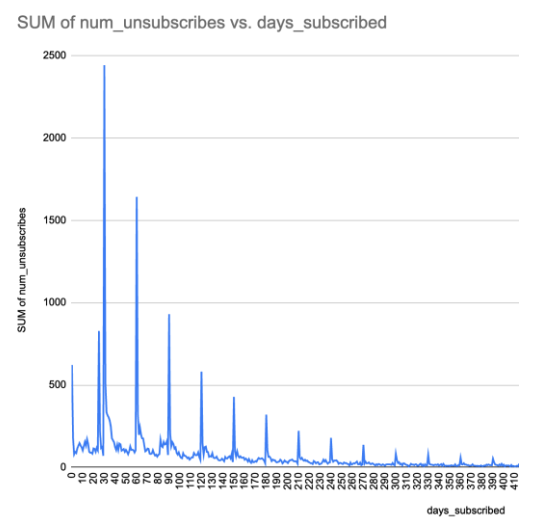
Retention curve showing unsubscribe patterns: Most churn occurs at 30, 60, and 90 days, with decreasing peaks over time. The dominant peak at 30 days (nearly 2,500 unsubscribes) highlights the critical first-month retention window.
As the graph illustrates, churn is highly concentrated around monthly intervals (30, 60, 90 days), with the most significant peak occurring around 30 days—right after the first shipment. This monthly churn pattern indicates that customers are evaluating their subscription after each delivery cycle. When analyzing churn, focus on customers who have completed at least their second order to understand true subscriber behavior. A typical churn pattern for true subscribers looks like:
- Order 1: 0% churn (baseline—all customers just received first order)
- Order 2: 15-30% churn (most churn happens here—value gap churn, product not meeting expectations)
- Order 3: 50% cumulative churn (critical milestone—half of customers have churned by this point)
- Order 6: 55-65% cumulative churn (churn rate slows—survivors are more committed)
- Order 12: 65-75% cumulative churn (long-term subscribers represent the remaining 25-35%)
Compare churn patterns across cohorts to identify if churn is increasing or decreasing over time. Focus your churn prevention efforts on the critical window between orders 1-3, where 50% of all churn occurs. This is where value gaps become apparent and where proactive intervention can have the greatest impact.
Churn by Customer Segment
Different customer segments have different churn patterns. Analyze churn by:
- Acquisition Channel: Organic vs. paid, email vs. social, etc.
- Product Type: Different products may have different retention rates
- Price Point: Higher-priced subscriptions often have better retention
- Geographic Location: Regional differences in retention patterns
Win-Back Campaign Strategies
Win-back campaigns target churned customers to reactivate their subscriptions. Effective win-back requires timing, messaging, and offers.
Win-Back Timing
- 30 Days Post-Cancel: First win-back attempt—they may have had a temporary issue
- 90 Days Post-Cancel: Second attempt—they've had time to miss the product
- 180 Days Post-Cancel: Final attempt—offer significant incentive if they were high-value
Win-Back Messaging
- Acknowledge Their Departure: "We noticed you're no longer subscribed"
- Highlight What's New: New products, features, or improvements since they left
- Offer Incentive: Discount, free shipping, or bonus product
- Create Urgency: Limited-time offer or exclusive access
Loyalty Program Impact on Retention
Loyalty programs can significantly improve retention by creating switching costs and emotional connection:
- Points-Based Programs: Accumulate points with each order, redeem for rewards
- Tiered Programs: Unlock benefits as customers reach higher tiers
- Referral Programs: Reward customers for bringing in new subscribers
- Exclusive Access: Early access to new products, special events, or content
Key insight: Reducing churn by even 5% can increase LTV by 25-95%. Retention is the highest-ROI growth lever. Focus your efforts on the critical window between orders 1-3, where 50% of churn occurs.