Works alongside
Plus Shopify. No migration, no checkout changes.
Skio’s Payment Recovery retries on the phases you configure and hands the messaging to a Klaviyo event you build yourself. MaxLTV runs the whole recovery on top of Skio as one integrated system: decline-aware retries, personalized email and SMS, the storefront prompt, subscriber-level churn prediction and reporting your finance team can audit. Skio keeps managing the subscriptions.
Works alongside

Plus Shopify. No migration, no checkout changes.
When a Skio subscription payment fails, Skio retries it according to the retry phases you set in Payment Recovery (Skio suggests a first phase of a three-day interval and seven attempts), charges a backup card automatically if the subscriber has one on file, optionally reshuffles the timing with Smart Retries, and sends a “Billing attempt failed” event to Klaviyo with the error code. Skio reports that about 15 percent of failed payments recover on retries alone; the rest need the customer to act.
The native behaviour, as documented by Skio. Worth knowing exactly, because it is the floor you are building on.
Payment Recovery lives under Retain. You set one or more retry phases, each with its own attempt count and interval; Skio suggests a first phase of a three-day interval and seven attempts, about three weeks in total.
Smart Retries shifts each retry to a time of day, day of week and day of month on rules Skio sets from its aggregate history, within the phases you configure. If the subscriber has a backup payment method, Skio charges it automatically when the primary card fails.
Skio sends a “Billing attempt failed” metric to Klaviyo for each failed charge, including the error code. The messages are yours to build, and Skio recommends waiting until several retries have run in the first two phases before notifying the customer.
Skio’s own guidance puts automatic recovery through retries at about 15 percent on average. Discount codes can be applied automatically in a later retry phase for the rest.
None of this is a flaw in Skio. Retry logic and scheduled notifications are billing features. Recovery is also a customer-behaviour problem, and even the retry itself works better when it is placed per decline, which needs a different set of tools.
Skio keeps managing the subscriptions. MaxLTV takes over recovery: the retries and every message around them, in one system.
A subscriber with an open failure sees a banner or notification the moment they land on your store, which is where many of them go instead of reading email.
Email and SMS split by failure reason and triggered by what the subscriber does, not only by the retry schedule. Sent from your own verified domain, with an exit check before every send so a recovered customer never gets another reminder.
Every message and prompt links straight to a secure payment-update flow. No password reset, no account page, no hunting for the subscription.
Every decline is classified and the retry placed when that card is most likely to authorize, with backup payment methods on file tried when the primary card is dead. Hard declines, including expired cards and emptied Shop Pay wallets, go straight to the card-update path because no retry will clear them.
Churn risk scored per subscriber daily, so intervention can start before the first failure, and recovery rate reported the way finance can audit it: retries alone versus card updates, by failure reason and by cohort.
MaxLTV is a managed engagement. The sequences, prompts and thresholds are set up and tuned by people who do this for subscription brands, not left as a template.
| Recovery lever | Skio alone | With MaxLTV |
|---|---|---|
| Retry timing | Rules-based: the retry phases you configure, with Smart Retries shifting the time of day | AI-driven: each retry placed by decline code for when the card is most likely to authorize, with backup payment methods on file and reduced-amount retries after repeated declines |
| Card update incentives | None. Discount codes apply to later retries, not to card updates | Incentives for updating the card, coordinated with the emails and the retry schedule |
| Customer messaging | Klaviyo “Billing attempt failed” event; you build the flow | Personalized email and SMS split by failure reason, with exit checks before every send |
| Trigger for messaging | Billing event | Adds behaviour triggers: store visit, email engagement, risk score |
| On-site prompt for an open failure | None | Banner or notification on the next visit |
| Churn prediction before the failure | Not part of Payment Recovery | Per-subscriber risk score, daily |
| Recovery reporting | Payment Recovery reporting | Adds the split: retries alone vs card updates, by reason and cohort |
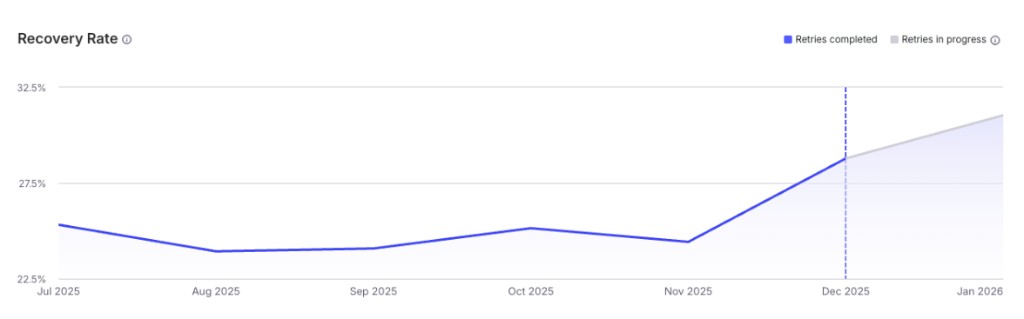
Bonafide moved its dunning to MaxLTV in December 2025. Recovery more than doubled, from about 24% of failed payments to roughly 55%, for a $2M annual LTV impact. The levers are the same on Skio.
A managed rollout, in stages, with no migration off Skio and no checkout changes.
We start with your Skio failure data: which reasons fail, what recovers on retries, what needs a card update, and what that is worth.
MaxLTV installs as a Shopify app and connects to your Skio store. Subscriptions, products and checkout stay in Skio.
Failure reasons map to retry rules, sequences and prompts. MaxLTV takes over from Skio’s Payment Recovery, so a failed charge is only ever retried and messaged by one system.
Flows go live in stages and recovery is reported split by retries versus card updates, so you can see what changed against Skio’s native recovery.
For recovery, yes. MaxLTV takes over retry timing and subscriber messaging as one integrated system: decline-aware retries, personalized email and SMS, the storefront prompt for subscribers with an open failure, per-subscriber churn prediction and recovery reporting split by retries versus card updates. Skio keeps managing the subscriptions themselves.
MaxLTV takes over that messaging, so the Klaviyo flow can be switched off and subscribers never get two reminders. In its place: email and SMS split by error code and sent from your own domain, exit checks before every send, a storefront prompt for the subscriber who visits instead of reading email, and card-update incentives coordinated with the retry schedule.
No. Recharge acquired Skio on 30 April 2026 and both platforms continue to operate. MaxLTV runs on top of either, so recovery you put in place now carries through a migration if you make one. See the Recharge page for that platform’s specifics.
Yes. MaxLTV’s retry logic tries the backup payment methods already on file when the primary card is dead, and customer messaging starts only after those attempts have failed too.
Two models: a managed engagement, or a performance partnership priced on recovered revenue. Pricing has the details, and the free churn audit shows what recovery is worth on your numbers before you commit.
Bring your Skio failed-payment export to the free churn audit. We will show you which failures are recoverable, what they are worth, and what to fix first.
Background reading: dunning best practices, recovery rate and decline codes and the payment recovery overview. Also for Recharge and Stay.ai.