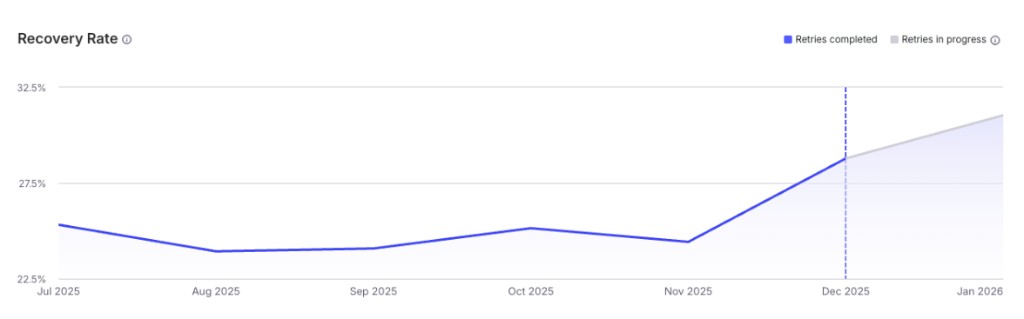
What changes in the numbers
Bonafide 2X’d their recovery rate with MaxLTV, from about 24% of failed payments to roughly 55%, for a $2M annual LTV impact.
FlyCode recovers failed payments. MaxLTV recovers failed payments and everything else that makes a subscriber leave.
FlyCode is a failed payment recovery tool. It retries declined charges with AI, routes to a backup card on file, and coordinates dunning email and SMS, priced on the revenue it recovers. MaxLTV covers all of that as the baseline and keeps going: your website, where a subscriber with an open failure is caught on their next visit, and voluntary churn, where subscribers cancel on purpose.
Failed payments are about 30% of subscription churn. FlyCode is built for that 30%. The other 70% are subscribers deciding to leave, and no payment recovery tool touches them.
AI retry timing, backup card routing, dunning email and SMS are table stakes. FlyCode treats them as the product. MaxLTV treats them as the starting point, because the subscribers those tools do not bring back are still your subscribers, and they are still leaving.
FlyCode stops at the retry and the inbox. That is where MaxLTV starts.
A subscriber who ignored three emails still browses your store. MaxLTV shows them the payment problem the second they land, with a one-click fix that needs no login. FlyCode has no presence on your site at all.
MaxLTV scores every subscriber's churn risk daily from order history, payment health, on-site behavior and email engagement. You act while there is still a subscription to save, not after the charge has already failed.
Failed payments are about 30% of subscription churn. The other 70% leave on purpose, and no payment recovery tool touches them. MaxLTV works both.
Every recovery is attributed to a retry or a card update, with a rate for each. That split tells you whether to fix your retry logic or your messaging. One blended number cannot.
MaxLTV reads Shopify order history, on-site behavior, email engagement and your subscription platform together. A failed charge is one signal in a customer record, not the only thing we know about them.
MaxLTV is a managed engagement. Sequences, thresholds and on-site targeting are set up and tuned by people who have run retention inside subscription brands, not left in a dashboard for your team to configure.
Most recovery tools report one number: revenue recovered. That number cannot tell you what to fix next.
Every recovery is attributed to a retry alone or to a customer updating their card, with a rate for each. That single split tells you whether your retry logic or your messaging is doing the work. It is the number most tools never show you.
A cohort view of how much of each week's failures came back by week one, two and four, what is still being retried, and what ended in a cancelled subscription. You see the shape of recovery, not one blended average.
Churn rate, cancel reasons, survival by order number and a revenue-at-risk view of every subscriber, sitting next to the recovery numbers. Payment recovery is one chart in a retention dashboard, not the whole dashboard.
One definition of recovery rate, applied the same way every month, with recovered revenue and recovered LTV alongside it and the underlying orders there to check. No black box between the failed charge and the dollar.
| Capability | FlyCode | MaxLTV |
|---|---|---|
| AI retry timing | Yes | Yes, placed by decline reason |
| Backup payment methods | Yes | Yes, attempted automatically |
| Dunning email and SMS | Yes | Yes |
| On-site payment failure banners | Not offered | Yes |
| No-login card update on your storefront | Not offered | Yes |
| Voluntary churn interventions | Not offered | Yes, before the cancel |
| Subscriber churn risk scoring | Not offered | Daily, per subscriber |
| Recovery reporting | Revenue analytics | Split by retries vs card updates, weekly and by cohort |
| Churn analytics beyond payments | Not offered | Churn rate, cancel reasons, survival by order, revenue at risk |
| Works on Recharge, Skio, Stay.ai, Ordergroove | Yes | Yes, no migration or checkout change |
| Retention strategy and implementation | Self-serve software | Managed by retention operators |
| Pricing | Share of recovered revenue | Managed engagement or performance partnership |
Bonafide 2X’d their recovery rate with MaxLTV, from about 24% of failed payments to roughly 55%, for a $2M annual LTV impact.
Not for retries. Two systems retrying the same failed charge will collide, and most subscription platforms warn against running two dunning tools at once. One system should own recovery. The churn audit uses your own data to show which one that should be.
It rarely is. Failed payments are about 30% of subscription churn. The other 70% is subscribers choosing to leave, and payment recovery tools do not touch that. The churn audit shows you your own split before you commit to anything, so you find out whether you are solving 30% of the problem or all of it.
Recovery rate, recovered revenue and recovered LTV, split by whether each recovery came from a retry alone or from a customer updating their card, reported weekly and by cohort. Alongside it: churn rate, cancel reasons, survival by order number, and a revenue-at-risk view of every subscriber. All on one definition your finance team can audit.
FlyCode charges a share of the revenue it recovers. MaxLTV offers a managed engagement or a performance partnership priced on recovered revenue. The free churn audit shows what recovery is worth on your numbers before you commit to either.
Pull your recovery rate by month for the twelve months around the day you switched it on, and split it by whether the recovery came from a retry alone or from a customer updating their card. If the line did not move, the tool is not earning its share. That comparison is the first thing the churn audit runs.
Bring your failed-payment export to the free churn audit. We will show you what is recoverable, what it is worth, and how much of your churn is not a payment problem at all.
Also compare: MaxLTV vs ChurnBuster. By platform: Recharge, Skio, Stay.ai, Ordergroove.