FlyCode Alternatives for Shopify Subscriptions
Most payment recovery tools sit at the payment layer and nowhere else, so they have one move: retry the card. MaxLTV has the rest of them.
What changes in the numbers
Nectar moved its retries from FlyCode to MaxLTV. Hundreds of renewals were failing every week on a product that no longer existed in Shopify. FlyCode had one move, so it kept retrying a card that was never the problem.
Nectar kept ~$52K in subscriber LTV from failures no card retry could fix
MaxLTV classified the failures as a store setup problem, not a card problem. Its operators matched every deleted variant to the live product by SKU, then retried once. 173 of 194 charges paid on the first attempt, in the first week of going live, before any gain from better retry rates.
More proof: Bonafide 2X’d recovery, from about 24% to roughly 55%, for $5.3M in recovered LTV
Payment recovery tools have an architecture problem
FlyCode sits at the payment layer and nowhere else. It sees a declined charge, retries it with AI timing, and routes to a backup card if one is on file. When that does not work, it does it again. One move.
That is fine when the card is the problem. It is useless when the problem is anywhere else: a product that no longer exists in Shopify, a subscriber who needs to be asked, a customer who is already on your site and could fix it in one click. A tool that only sees the payment cannot tell the difference.
Good retry logic recovers about 15%. That is the ceiling.
That is not a knock on retry logic. It is what AI-timed retries can do on their own, and MaxLTV runs them too. Everything above 15% has to come from somewhere else: email and SMS that land, a storefront that catches the subscriber on their next visit, and knowing what actually went wrong before the next attempt.
FlyCode treats retries as the product. MaxLTV treats them as the first move.
The moves FlyCode doesn't have
Retrying the card is where MaxLTV starts, not where it stops.
They retry. We find out what went wrong first.
MaxLTV classifies every decline before it retries. A card that is short gets a retry. A closed card gets a customer update request. A store setup failure, like a deleted variant, gets fixed. Nectar's charges were retried up to 17 times by a tool that never checked.
They stop at the inbox. We own the storefront.
A subscriber who ignored three emails still browses your store. MaxLTV shows them the payment problem the second they land, with a one-click fix that needs no login. FlyCode has no presence on your site at all.
They hand you software. We put operators on it.
Finding Nectar's deleted product, mapping seven variants by SKU and running the bulk import took someone who knows Recharge and Shopify. That expert-level support is part of every MaxLTV engagement, not a dashboard for your team to configure.
They wait for the decline. We move before it.
MaxLTV scores every subscriber's churn risk daily from order history, payment health, on-site behavior and email engagement. You act while there is still a subscription to save, not after the charge has already failed.
They recover payments. We keep subscribers.
Failed payments are about 30% of subscription churn. The other 70% leave on purpose, and no payment recovery tool touches them. MaxLTV works both.
They report revenue recovered. We report what recovered it.
Every recovery is attributed to a retry or a card update, with a rate for each. That split tells you whether to fix your retry logic or your messaging. One blended number cannot.
They see your payments. We see your subscribers.
MaxLTV reads Shopify order history, on-site behavior, email engagement and your subscription platform together. A failed charge is one signal in a customer record, not the only thing we know about them.
Built-In Analytics. Automated Reporting. Clear ROI.
FlyCode's reporting is manual and minimal. MaxLTV's is automatic, and it tells you what to fix next.
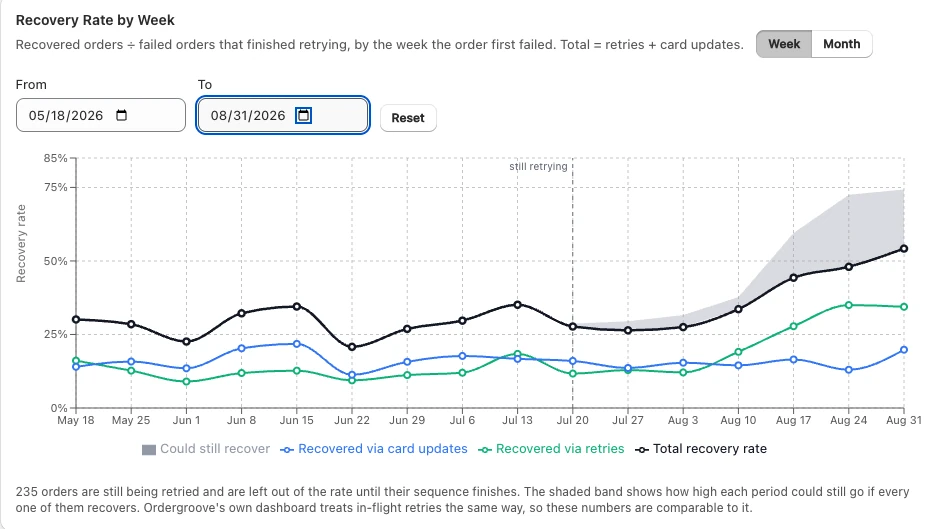
Recovery split by how it happened
Every recovery is attributed to a retry alone or to a customer updating their card, with a rate for each. That single split tells you whether your retry logic or your messaging is doing the work. It is the number most tools never show you.
Recovery by week since the failure
A cohort view of how much of each week's failures came back by week one, two and four, what is still being retried, and what ended in a cancelled subscription. You see the shape of recovery, not one blended average.
Churn analytics past the payment
Churn rate, cancel reasons, survival by order number and a revenue-at-risk view of every subscriber, sitting next to the recovery numbers. Payment recovery is one chart in a retention dashboard, not the whole dashboard.
Numbers your finance team can audit
One definition of recovery rate, applied the same way every month, with recovered revenue and recovered LTV alongside it and the underlying orders there to check. No black box between the failed charge and the dollar.
Feature-by-feature comparison
| MaxLTV | FlyCode | |
|---|---|---|
AI retry timing | Yes, placed by decline reason | Yes |
Backup payment methods | Yes, attempted automatically | Yes |
Dunning email and SMS | Built in, timed with the retries | Not built in |
Decline classification before retrying | Card, customer or store setup, each handled differently | Retries the card |
On-site payment failure banners | ||
No-login card update on your storefront | ||
Voluntary churn interventions | Yes, before the cancel | |
Subscriber churn risk scoring | Daily, per subscriber | |
Recovery reporting | Automatic, split by retries vs card updates, weekly and by cohort | Manual and minimal |
Churn analytics beyond payments | Churn rate, cancel reasons, survival by order, revenue at risk | |
Works on Recharge, Skio, Stay.ai, Ordergroove | All four, no migration | Recharge, Skio, Stay.ai |
Retention strategy and implementation | Managed by retention operators | Self-serve software |
Pricing | Pay for performance or flat fee | Share of recovered revenue |
Frequently asked questions
Can I run MaxLTV and FlyCode at the same time?
Not for retries. Two systems retrying the same failed charge will collide, and most subscription platforms warn against running two dunning tools at once. One system should own recovery. The churn audit uses your own data to show which one that should be.
If FlyCode already uses AI retries, what does MaxLTV add?
The same retries, plus every move a payment-layer tool cannot make. Good retry logic recovers about 15% of failed payments on its own. The rest comes from classifying each decline before acting on it, email and SMS that land, on-site recovery for subscribers already in your store, and operators who fix the cause when it is not the card. Nectar's first week is what that looks like.
What if failed payments are my only problem?
It rarely is. Failed payments are about 30% of subscription churn. The other 70% is subscribers choosing to leave, and payment recovery tools do not touch that. The churn audit shows you your own split before you commit to anything, so you find out whether you are solving 30% of the problem or all of it.
What reporting do I get?
Recovery rate, recovered revenue and recovered LTV, split by whether each recovery came from a retry alone or from a customer updating their card, reported weekly and by cohort. Alongside it: churn rate, cancel reasons, survival by order number, and a revenue-at-risk view of every subscriber. All on one definition your finance team can audit.
How is MaxLTV priced compared to FlyCode?
FlyCode charges a share of the revenue it recovers. MaxLTV lets you choose: pay for performance, priced on recovered revenue, or a flat fee. The free churn audit shows what recovery is worth on your numbers before you commit to either.
How do I tell whether my current tool is working?
Pull your recovery rate by month for the twelve months around the day you switched it on, and split it by whether the recovery came from a retry alone or from a customer updating their card. If the line did not move, the tool is not earning its share. That comparison is the first thing the churn audit runs.
Find out how much is stuck behind one move.
Bring your failed-payment export to the free churn audit. We will classify the failures, show you what retries alone will never bring back, and what it is worth.
Also compare: the best way to reduce churn, Churn Buster alternatives, Churnkey alternatives, Butter Payments alternatives, Redux Payments alternatives. By platform: Recharge, Skio, Stay.ai, Ordergroove.