Redux Payments Alternatives for Subscription Brands
Redux picks up where Stripe's retries stop. MaxLTV picks up where your subscription app's recovery stops, and keeps going into the inbox, the text thread and your storefront.
Built for subscription brands, proven on them
Retry timing is one input. The brands that move recovery the most also reach the subscriber, in their inbox and in the store.
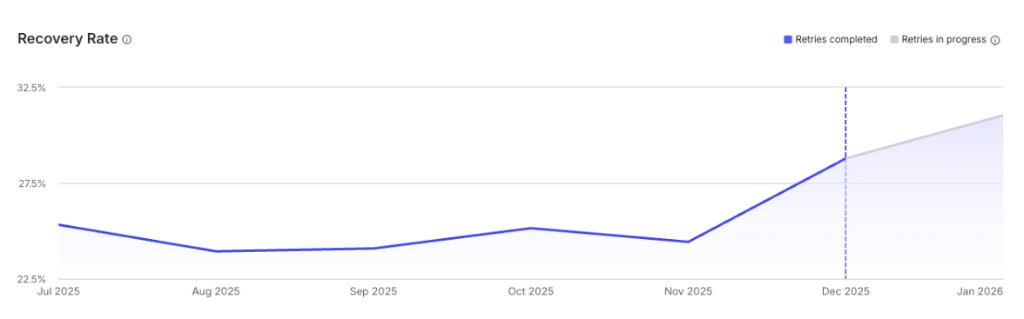
Bonafide more than doubled recovery, from ~24% to ~55%
Bonafide switched its failed-payment recovery to MaxLTV in mid-December 2025: AI-timed retries, payment-update links that open a card-update flow in the store, and on-site prompts for subscribers who are already logged in. Recovery moved within 30 days. No new hires and no complicated migration.
Redux is a Stripe tool. Your subscriptions run on a subscription app.
Redux works inside your Stripe account: it swaps Stripe's retry schedule for AI-timed retries and sends recovery emails with a card-update form. It never leaves Stripe and the inbox.
Many subscription brands don't bill on Stripe directly. Their renewals run through Recharge, Skio, Stay.ai or Ordergroove, and Redux's site names none of them. Even where the card sits in Stripe, the subscription, the retry schedule and the customer's account live in the subscription app.
MaxLTV runs on top of that app, and reaches the subscriber everywhere a Stripe tool can't: by text, and on your storefront.
Billing directly on Stripe? MaxLTV's headless version runs on Stripe Billing too, so you get everything below without a subscription app in between.
What MaxLTV does that Redux doesn't
Smart retries are where MaxLTV starts.
They tune Stripe. We work with your subscription app, or Stripe.
MaxLTV runs on top of Recharge, Skio, Stay.ai and Ordergroove with no migration and no checkout change, or headless directly on Stripe Billing, and owns retries and messaging together.
They send an email. We reach subscribers everywhere.
Personalized email and SMS, timed with every retry, plus a banner and a one-click, no-login card update when the subscriber lands on your store.
They read the decline. We find the real cause.
MaxLTV classifies every failure as a card, customer or store setup problem. A deleted product or broken variant gets fixed by our operators instead of retried.
They recover payments. We keep subscribers.
Failed payments are about 30% of subscription churn. MaxLTV also scores every subscriber's churn risk daily and intervenes before they cancel.
They run on autopilot. We put operators on it.
MaxLTV's retention operators know your subscription app and your billing. They run the cutover, fix the store when the card isn't the problem, and bring a quarterly roadmap.
We show you what recovered it.
Every recovery is attributed to a retry or a card update, weekly and by cohort, so you know whether the retry logic or the messaging is doing the work.
Feature-by-feature comparison
| MaxLTV | Redux Payments | |
|---|---|---|
Built for | Subscription brands, on a subscription app or Stripe Billing | Brands billing on Stripe Billing |
Works on Stripe Billing | Yes, with our headless version | Yes |
Works on Recharge, Skio, Stay.ai, Ordergroove | All four, no migration | |
AI retry timing | Yes, placed by decline reason | Yes, inside your Stripe account |
Store setup fixes (deleted products, broken variants) | Done by our operators | |
Recovery email | Personalized, timed with each retry | White-labeled, with card-update forms |
SMS | Yes, timed with each retry | |
On-site banners and no-login card update | Yes, on your storefront | |
Voluntary churn interventions | Daily risk scoring, before the cancel | |
Pricing | Pay for performance or flat fee | Share of lift over Stripe's own retries |
Frequently asked questions
What is the difference between MaxLTV and Redux Payments?
Redux is a Stripe tool: it replaces Stripe's retry schedule with AI-timed retries inside your Stripe account and sends white-labeled recovery emails with card-update forms. MaxLTV is built for subscription brands. It runs on top of Recharge, Skio, Stay.ai and Ordergroove, or headless directly on Stripe Billing, classifies every failure before acting on it, times email and SMS with each retry, catches subscribers on your storefront with a no-login card update, and scores churn risk so it can act before a payment fails.
Does Redux Payments work with Recharge or Skio?
Redux's site describes it as built for brands on Stripe Billing and names no subscription app. If your subscriptions run through Recharge, Skio, Stay.ai or Ordergroove, MaxLTV runs on top of them with no migration and no checkout change.
Does MaxLTV work on Stripe Billing?
Yes. MaxLTV's headless version runs directly on Stripe Billing, with no subscription app in between. Brands billing on Stripe get the same decline classification, retries timed with email and SMS, churn-risk scoring and retention operators as brands on Recharge, Skio, Stay.ai or Ordergroove.
How does Redux pricing compare with MaxLTV?
Redux takes a share of the lift above your Stripe Smart Retries baseline. MaxLTV lets you choose: pay for performance, priced on recovered revenue, or a flat fee. The free churn audit measures your current recovery rate first, so you know your real baseline before you pay anyone on lift.
Can I run MaxLTV and Redux at the same time?
Not on the same failed charges. Two systems retrying one charge collide. One system should own recovery, and it has to work with whatever runs your subscriptions.
Recovery built for your subscription app, not just your processor
Bring your failed-payment export to the free churn audit. We'll measure your real baseline, show you what retries alone miss, and what it's worth.
Also compare: the best way to reduce churn, Churn Buster alternatives, Churnkey alternatives, Butter Payments alternatives, FlyCode alternatives. By platform: Recharge, Skio, Stay.ai, Ordergroove.